A Personal Time Capsule Without the Clutter
A personal time capsule can preserve what mattered without filling a box: choose a few durable keepsakes and record the memories that give them meaning.
You open a drawer looking for a birthday card and find a stack of old tickets, a cracked key ring and notes you cannot place. A personal time capsule can hold the meaning of a period without preserving every object from it. The useful question is not “What might I want later?” but “What would help me remember how this felt?”
A small capsule works best as a considered record, not a miniature archive. Over a week, you can select a handful of durable keepsakes, write down their stories and decide what deserves a place. Nothing needs to be rare or valuable. The point is to keep a few objects that open a clear door into memory.
What should a personal time capsule preserve?
Choose objects that connect you to a person, a routine, a place or a decision. A plain café loyalty card might recall the conversations that filled a lunch break; a handwritten recipe could carry a relative’s way of explaining things. The object is a prompt. The memory attached to it is the substance.
Favour items that are already durable and complete. A postcard, a paper map, a fabric patch, a small printed photograph or a non-perishable token may work. Avoid keeping food, liquids, living material or anything that could leak, decay or become unpleasant. You are making a memory aid, not trying to seal a whole room inside a container.
Before you choose, notice what the object brings back without prompting. Does it call up a specific scene, or does it merely seem as though it ought to be meaningful? A keepsake need not look special, but you should be able to name its connection in a sentence.
How can you make the selection over a week?
A week gives memories time to surface and lets you resist the urge to save everything at once. Set aside a short, unhurried moment each day. Keep a running list on paper or in a notes app, but do not collect objects simply because they are nearby.
- Day one: Set the frame. Decide what period or chapter the capsule will represent: a move, a school year, a new routine or an ordinary season. Write a simple description of its boundaries so the collection does not expand to cover your whole life.
- Day two: List the recurring details. Note a familiar journey, a meal you made often, a phrase someone said or a place you returned to. These everyday details can be more evocative than a single grand occasion.
- Day three: Find possible objects. Look only at items already in your possession. Make a short candidate list, such as a bus ticket, a recipe card or a postcard, without adding anything to your shopping basket.
- Day four: Ask what each item recalls. Write a sentence beside each candidate. If you cannot explain its connection, set it aside rather than asking the object to carry a story it does not hold.
- Day five: Choose a small set. Keep a few different kinds of memory, rather than several objects that all stand for the same event. Leave room for a note that captures something no object can represent.
- Day six: Write the context. Record who, where and why, along with any detail a future reader would not know. Keep it plain and specific; a short note can preserve more than a polished account.
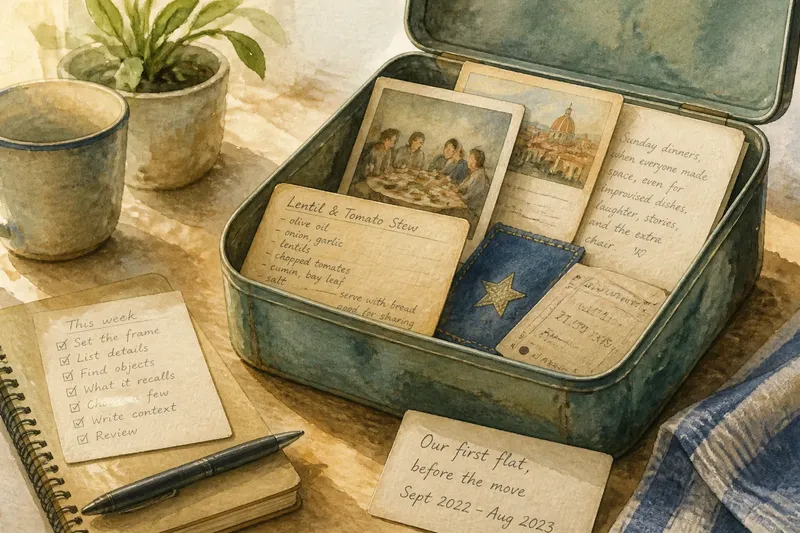
- Day seven: Review the collection. Read your notes and look at the objects together. Remove anything that feels included from obligation, then give the capsule a clear name and date range in words, such as “Our first flat, before the move”.
What makes a keepsake worth keeping?
Try a simple test: can you finish the sentence “I chose this because…” with a concrete memory? “Because it was important” is too vague to help later. “Because I carried it on the evening we decided to move closer to my sister” gives the object a specific place in your story.
Say you are marking a season when your household began sharing Sunday dinners. You might choose a handwritten menu, a postcard from a guest who travelled to join you and a small paper card bearing the recipe everyone requested. Beside each, you record who was there and one detail worth remembering, such as the dish that was improvised when an ingredient was missing. The expected result is a small collection that recalls both the gathering and its ordinary texture, rather than a pile of packaging and leftovers.
Consider balance, too. If every item belongs to one person, the capsule may describe your relationship with them more than the period as a whole. That may be exactly right; if not, add a token of a routine, a place or your own changing interests. The aim is not to achieve a formal quota but to notice what the collection leaves out.
How should you record why the objects matter?
Use a separate note for each object, on a small card or in a digital document. Include a name for the item, an approximate time or context, the people involved and the memory it prompts. If the exact date is uncertain, say so instead of guessing.
Write for someone who does not share the moment—including your future self. “The blue card from the corner bookshop” is more helpful than “that card”. Explain why it stayed with you, but do not force the memory into a lesson or a neat ending. Sometimes the honest note is simply that you miss a familiar place.
A digital note can sit alongside physical keepsakes, especially when an item is too large or fragile to include. You might describe the object, record the words on it or make a digital copy where appropriate. Keep the original story legible without depending on a photograph to explain what the image cannot show.
Which questions help you finish the capsule?
How many objects should I include?
There is no required count. Choose only as many as you can explain clearly, and stop when each main thread of the period has a prompt.
Can an ordinary object be meaningful?
Yes. A familiar token can bring back a routine or conversation precisely because it belonged to daily life. Its meaning comes from the memory you record, not its price or rarity.
Should I include photographs?
Include one if it recalls a scene that matters and you can identify the people or setting. A brief caption can preserve context that may not be obvious from the image alone.
What if I cannot decide whether to keep something?
Leave it out for now and write down the memory instead. If the story still matters when the object is absent, you have preserved the part that gives the capsule its purpose.
How can the capsule stay small in meaning as well as size?
Make the boundary part of the record. Name the period, the reason you selected it and what you deliberately left outside its scope. That note prevents a time capsule from becoming an ongoing duty to document every occasion.
When the week ends, read the notes once without editing them into a grand narrative. Add a missing name or explanation if it would genuinely help you recognise the memory later. Then let the collection stand. A personal time capsule is most useful when it gives attention to a few chosen details, leaving the rest of life free to move on.
For a personal time capsule without clutter, the lasting decision is not which objects seem most impressive, but which ones still have a story when you explain them plainly. Keep the story with the keepsake, and the object no longer has to carry the whole past by itself.