Why Soap Bubbles Show a Shifting Rainbow
Why do soap bubbles show a shifting rainbow? See how light in the thin film produces shifting colours, and learn why viewing angle and thickness matter.
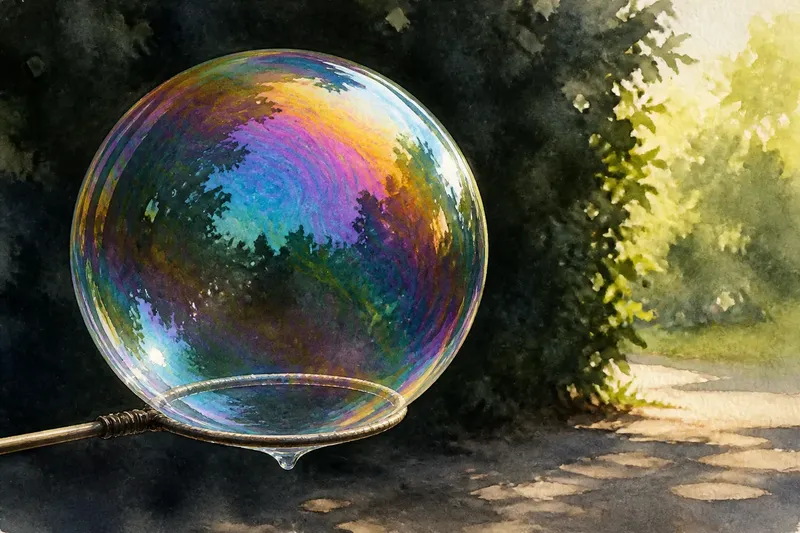
Why do soap bubbles show a shifting rainbow? Watch a bubble drift past a dark hedge and its colours may slide, fade or flare as it turns. The rainbow comes from light reflecting within the bubble’s thin film, not from coloured soap.
The film has an outer surface facing the air and an inner surface facing the air trapped inside. Light can reflect from both. Those reflected waves meet, sometimes reinforcing one another and sometimes partly cancelling, depending on the light’s colour and the film’s thickness.
How does a thin film make colour?
White light contains many visible colours, each with its own wavelength. Red light has a longer wavelength than blue light. As light reflects from the two surfaces of the film, the waves for each colour can return out of step or in step with one another.
One portion of the light reflects from the outer boundary. Another passes into the film, reflects from the inner boundary and comes back out. The second portion travels farther within the film. If the waves for a particular colour line up, that colour looks stronger; if they partly cancel, it looks weaker.
This is called thin-film interference. The film does not contain separate painted stripes of colour. Instead, it changes which parts of the light are reflected towards your eye. The viewing angle can change the result, too.
Why does bubble thickness change the colours?
The film’s thickness affects the extra distance light travels inside it. A change in that distance changes how the reflected waves line up, so one colour may fade while another becomes more noticeable. The angle at which light enters and leaves the watery layer also matters.
There is no simple rule that assigns a particular colour to every visible patch. Thickness, viewing angle and the light source all shape the colours you see. That is why the pattern is a shifting mix rather than a fixed sequence of bands.
Imagine a bubble resting on a wire loop in a still room. If liquid drains down from its upper part, the film there becomes thinner. As you watch from the same spot, the upper area may change colour, while a thicker area lower down may show a different mix. The observable result is a moving pattern, not coloured liquid flowing across the surface.
What makes the rainbow move?
A bubble’s film is fluid, so its thickness changes. Gravity draws liquid downwards, while surface tension helps the film hold together. Air currents, the bubble’s movement and evaporation can also alter the layer. Each change can shift which colours are reinforced.
The movement may be subtle: one hue fades as another strengthens, or a band creeps across the curved surface. The curve means you see different parts of the film at different angles. Even if a patch stayed the same thickness, a change in your viewpoint could alter the reflected colours.
As a film becomes extremely thin, the reflected light can become weak, and some areas may appear dark. But darkness is not a dependable sign that a bubble is about to burst. Lighting, viewing angle and local changes in the film all affect what you see; a dark patch may be hard to interpret on its own.
Why doesn’t a bubble keep one rainbow?
A bubble is not a rigid shell with a stable thickness. Its soapy liquid continually redistributes, and the film can thin unevenly. The rainbow is a changing map of those conditions, not a permanent pattern attached to the bubble.
Soap helps water form a film by lowering its surface tension. The film still drains and evaporates, however, so soap can help it persist without freezing its colours in place.
Lighting matters as well. A bright, broad source of white light can reveal a range of reflected colours, while a dark background can make them easier to pick out. Under coloured light, the film can only reflect strongly colours present in the illumination.
What else might you want to know about bubble colours?
Are the colours caused by dye in the soap?
The shifting rainbow usually comes from interference in the thin film, not dye. A coloured solution could tint the bubble, but that would be a separate effect from the changing interference colours.
Why can a patch look black?
A patch can look dark when little visible light is reflected towards you. Interference may contribute, but the appearance also depends on illumination, angle and the film’s local condition, so darkness alone does not reliably predict when the film will break.
Would a bubble look the same from every angle?
No. Changing your angle changes the route light takes through the film and can alter which colours reinforce one another. Moving your head may reveal a different mix even when the bubble seems still.
Can other surfaces show similar colours?
Yes. Thin oil films on wet pavement can produce related colours through interference. The material and shape differ, but reflected waves still combine according to the layer and the viewing angle.
How can you observe the shifting rainbow?
Let a bubble drift against a plain, shaded background and watch one small patch rather than trying to follow the whole surface. Notice whether a colour strengthens as another fades, then move your head slightly to see whether the mix changes. This is a simple way to observe why soap bubbles show a shifting rainbow: each colour’s reflection depends on the film beneath it and the angle from which you see it.
If a bubble darkens, treat that as an interesting change in reflected light, not a countdown to its burst. The useful clue is the pattern’s movement: it shows how a film too thin to see directly can still reshape the light reaching your eye.